It takes about eight hours of driving north to get to Ely, MN, right on the edge of the Boundary Waters Canoe Area, or BWCA, a designated wilderness area in northern Minnesota, on the border of Canada. I had packed everything I needed for a three-day trip, but I was concerned that my pack was too small, and too awkward to carry along with my food pack and a canoe. I was interested instead in getting a dedicated portage pack.
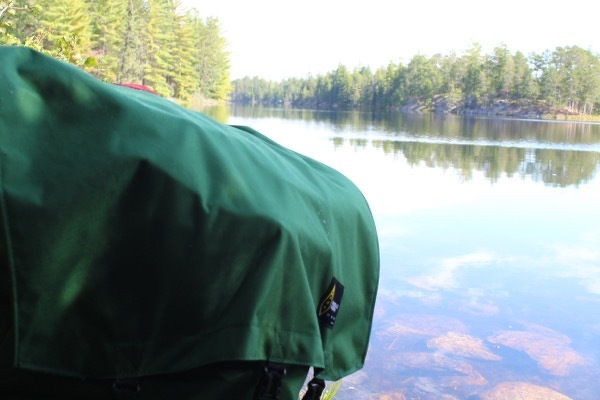
A portage pack is bigger, shorter, more square or rectangular, sits well in a canoe, and is built for moving from one lake to another along a portage trail. It’s not built for multi-day camping and hiking trips through the mountains, I’ve got my other backpack for that. I was hoping I’d be able to do a single portage, which meant carrying all my gear and my canoe through the portage in one go, instead of having to drop stuff on one end and trek back to get the rest of it in a second trip. So, I visited a place called Portage North with the intention of buying a 120L Voyageur 4 pack.
When I found the small shop in Ely, the first thing I noticed was that it looked abandoned, except for a small note taped to the door that said “come in, we’re here!” Inside was a small display area with different packs, a counter, and behind the counter a larger space with a couple of sewing machines. A man behind the counter saw me come in and asked if he could help, and I told him what I was looking for. He asked when I was heading out, I told him I was leaving first thing in the morning. He said he didn’t have any of the Voyageur 4 packs right now, but asked if I could come back in an hour and a half. I asked what he was going to do in an hour and a half and he looked at me like I wasn’t following the conversation correctly and replied “I’m going to make you one.”
So I did, and he did, and now I’ve got a custom-made, tough-as-nails portage pack that I absolutely love.1 After spending some time in a sauna I went back to the hotel and repacked everything, emptying my hiking backpack into the portage pack, and found I had room to spare.
Into the Woods
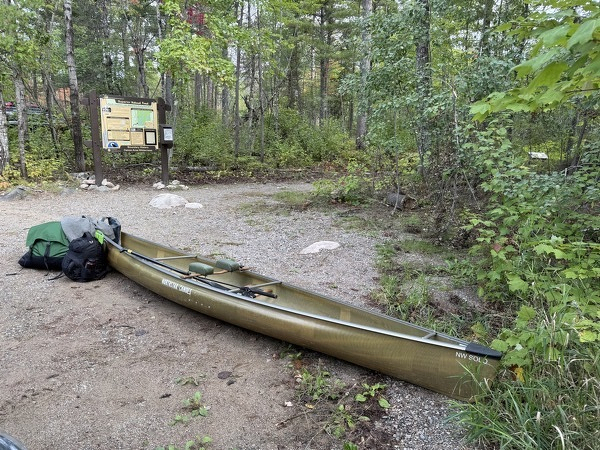
This was my first solo trip into the BWCA, so I didn’t want to press my luck and get too ambitious. I picked a reasonably easy portage, and planned to camp just on the far side of the entry point. Despite what my mind tries to tell me, I’m actually a desk worker who’s nearly 50, and while I’m reasonably active and fit, I’m not nearly as fit as I was 20 years ago. A fact I had to face head-on trying to do the single portage to the lake. I got my portage pack on my back, my small backpack carrying my BearVault food canister (more on that later) on my chest, picked up the canoe onto my shoulders, and then carried my fishing pole and paddle in one hand and guided the canoe with the other.
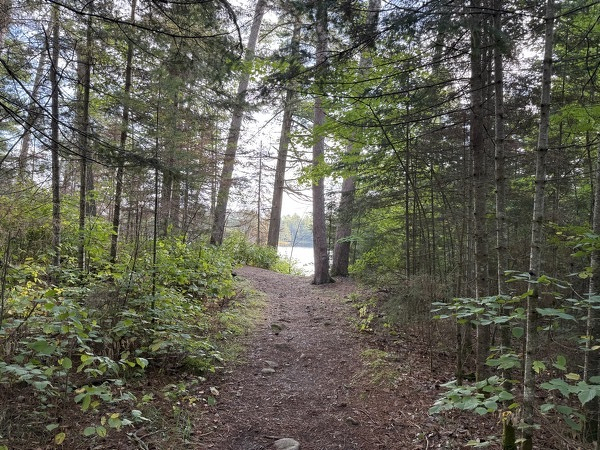
I did fine for a bit, but this is a wilderness area, and the portage trail is just a trail through the woods with ups and downs, bits with slippery rock, and 36 stairs at the end going to the lake. I slipped at one point and was brought down to one knee. No problem, I thought, I’ll just stand back up. I could not for the life of me stand back up. At that point it became abundantly clear to me that I needed to incorporate far more strength training into my exercise regimen. With no other choice, I carefully set the canoe to the side with the fishing pole and paddle, and carried the heavy packs the rest of the way down, left them by the lake, and made a second trip. So much for single portage.
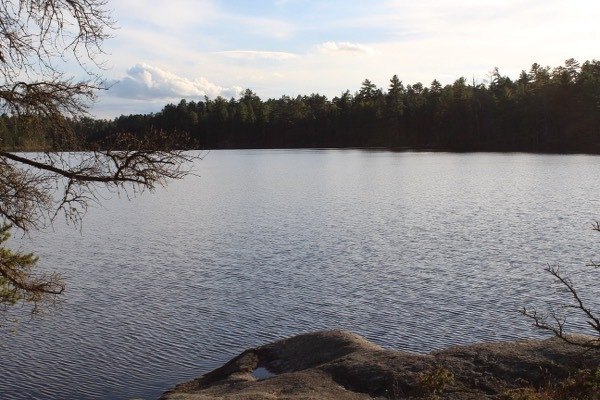
The lake I was on was absolutely beautiful. It wasn’t so big that waves would make canoeing difficult. And it was not too small so that it didn’t just feel like a big pond. The weather was perfect, there were no bugs, I really couldn’t have asked for a better time or place to be on the water. Eager to find a good camping spot and get set up, I paddled out towards the one I had picked out on a map as my first choice. After 20 minutes or so I found the right area, but unfortunately I saw camp chairs and other signs of occupation, so I headed north towards my second choice. It took a half hour or so of easy paddling, but as soon as I saw the campsite I knew that my second choice should have been my first choice.
The campsite was big, protected on all sides by trees, had a nice fire pit, and plenty of flat ground to pitch a tent on. I pulled my canoe in, unpacked and pitched my tent, hung my hammock, got the camp chair my friend loaned me set up by the fire pit, and figured it was time for lunch. That chair, by the way, was worth its weight in gold. I’m buying my own before I head back out on my next trip and don’t plan on camping without one now.
Camping
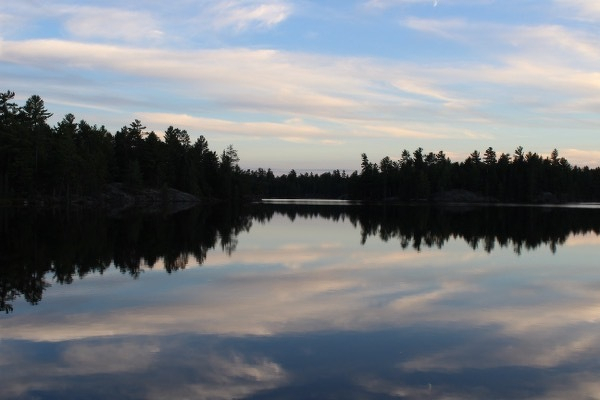
The rest of the day went by uneventfully, which is to say, exactly as I wanted it to go. I went fishing, caught some perch that were too small so I threw them back, hiked a bit on the trails behind the campsite, just to explore the area. Tried hanging the BearVault between two trees but realized that the ropes that I had brought had far too much flex in them for this to be a reasonable storage method. I settled for just stashing the canister in a little divot some 50 yards away from the campsite. I waded into the lake to get water to run through my filtration system, which is really just a plastic bag hung from a tree with a filter at the bottom that I’d drain into a water bottle. After cooking up an extremely good bacon-wrapped steak for dinner, I slipped into my tent and sleeping bag for a good night’s rest.
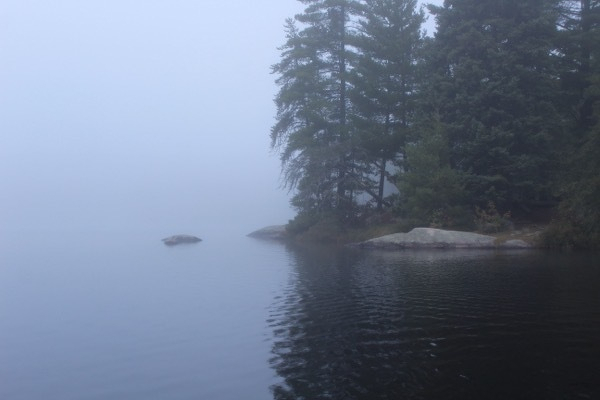
The next morning felt like waking up in a different world. A thick fog had settled over the entire lake and this world was silent. It’s hard to describe true silence when you haven’t actually experienced it for a while. There were no birds, no animal sounds. No motors humming, no cars, no electric whine of lights that we’ve learned to tune out. Just silence. Incredible, profound silence. Used my Pocket Rocket to boil water for coffee, then sat in the chair by the lake and just watched for a while. No phone, no TV. Just sitting in silence on a foggy morning, enjoying my coffee.
Near Disaster, But Not Really
After a while, and a second cup, I decided I wanted to explore the area more, and see about some fishing besides. Surveying the campsite I decided I wanted to grab my fishing pole and lures, the Pocket Rocket, AeroPress, and coffee for later, some snacks from the BearVault for lunch, and my camera pack to take pictures. I set about gathering all of those things, grabbed the canoe, loaded up all the stuff, got in the canoe myself, reached back to grab the paddle, and there was no paddle.
The canoe had already started to drift away from shore, so I first tried to paddle back with my hands, which was ridiculous and obviously not going to work. So I did the only thing I could and jumped out of the canoe into the cold water. Of course, jumping out just pushed the canoe farther away from shore, so I had to dive after it to grab it and pull it back. In the course of about 10 seconds I went from easily getting ready for a day on the water to completely soaked from the neck down. If the canoe had floated any further away I would have had a problem. Not an insurmountable one, but a problem nonetheless.
So, soaked to the bone, I had to strip out of everything I was wearing, my jacket, shirt, pants, and cold-weather gear and hang them up from various trees around the campsite. Luckily I had thought to bring a towel so I was able to dry off, then get my other set of clothes I’d packed out. Once I was warm and dry again, I made sure I grabbed the paddle and set out.
Well, “warm and dry” to a point. When you are canoe camping, you should always bring two pairs of shoes, wet shoes for the canoe, and dry shoes for camp. My wet shoes were always soaked, which meant my feet were pretty much always cold in the canoe. I didn’t care too much though, because floating on the canoe in the morning fog felt like being completely alone in the world.
The Rest
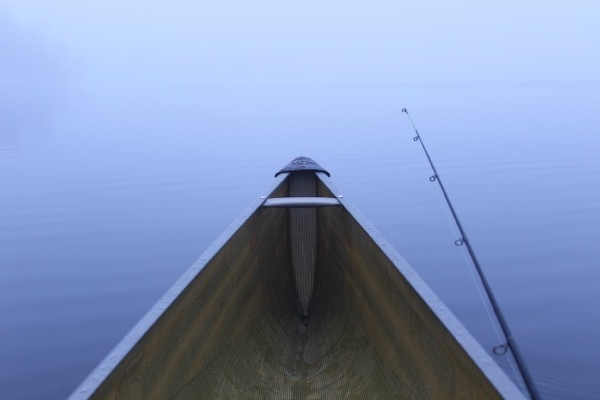
The rest of the trip passed by uneventfully. I got lonely after a while, I spent a lot of time in deep thought. I foraged for dry branches and birch bark on the ground that I could use for campfires. I thought I was eating all the time, but when I got back home I found that I had lost seven pounds. I fished more, but being September the walleye weren’t biting, there were no pike to be found, and the few perch I was able to catch were too small to keep. At night I slept hard. The second night I woke up to hear an animal checking out my campsite, and I heard it sniffing around my tent. I thought about sticking my head out of the tent to see what it was, but it was cold out there and I was warm and tired in my sleeping bag, and just couldn’t be bothered. So I made some noise to drive it off and went back to sleep.
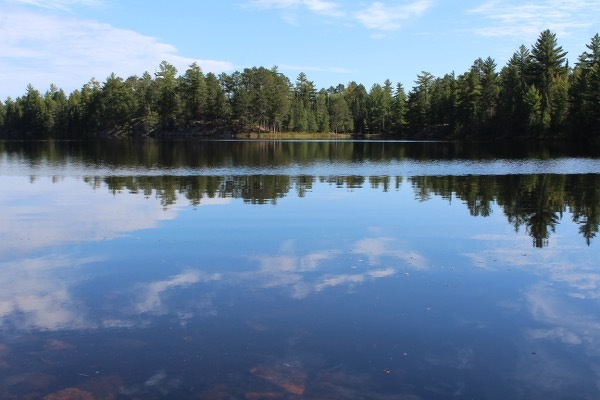
Oh right, the BearVault. I hated this thing. I understand its necessity, but this was more than just bear proof. The way it works is that it’s round and smooth, and too big to fit in a bear’s mouth. The top screws on and has two thick plastic tabs that click in to secure the top in place, and to open it you have to press in on the top and simultaneously rotate the top to clear the two tabs. So many times I’d try to open it, but my hands would be too cold and I’d just sit there and struggle with it for a few minutes till I’d set it aside in frustration, only to remember that my dinner was inside and I had no choice but to try harder and get it open. I think they get a little easier to open with time, but this one was brand new, stiff, and unforgiving. I’d eventually get it open, and I suppose it’s better than losing my meals to a bear, but good grief was it frustrating.
On the third day I fished more, made more coffee, took a dip in the lake, and some time in the afternoon decided to pack up camp. I spent that night in a hotel so I’d be fresh for the long drive home.
It was an incredible trip, and I’m glad to have done it, but I think in the future I’d like to bring someone along, or go with a group. Spending a few days alone in the wilderness is good for you, but now that I’ve done it I’m happy to go with friends or family next time. In fact, I’ve already started planning another trip next September. Maybe even a Spring trip as well, we’ll see how it goes. Regardless, I’ll be back.
-
I’m trying to come up with more uses for it, but it’s a specialized piece of equipment. So, for now, it’s in storage with the rest of my camping gear. ↩︎