Or, Redesigning the Tablet Computer
This is an old paper I wrote in college in the Spring of 2006. I wrote
this before the iPad, iPhone, or iOS was released, so it looks a
little silly and dated now, but I still want to keep it around.
Evolution
Somewhere around 2000 BC, man discovered that mathematics were not
exactly his strong suit. It became apparent that by using a tool
external to his mind he could perform far more advanced calculations
than he could in his head. Thus, the
abacus was born, the first
computer.
Evolution of Computers
Computing technology stagnated for thousands of years before taking a
giant leap forward in the 1970’s. Advances in other fields of science
led to the creation of vacuum tubes and punch cards that were used in
the first fully mechanical and programmable computers. The first
computers were big enough to fill a large room, and had (relatively)
little computing power. Over time, the computer internal components have
grown smaller and smaller, to the point that now you can carry a
computer with several magnitudes the computing power of the first
machines in the palm of your hand.
While computer architecture has undergone several changes, the basic way
people interface with the computer has only undergone two major
transitions. The first transition was the changefrom purely mechanical
forms of data input like punched cards, to a digital interface via a
command line. The command line is a simple text interface where a
person types in data on a keyboard, and the computer returns information
based on what the person typed. The second transition in user-computer
interface was the move away from the command line to a Graphical User
Interface, or GUI for short. According to
Wikipedia:
“A GUI is a method of interacting with a computer through a metaphor
of direct manipulation of graphical images and widgets in addition to
text.”
The most recognizable computer GUI is the interface to Windows XP. XP
uses a “desktop” and “filing cabinet” metaphor to symbolize the location
of files in within the system. While this works great for simple filing
systems, the amount of data needed to keep track of quickly out grows
the now outdated system.
Necessity
The computer has grown smaller and larger at the same time. The physical
size of computers has decreased, while the computing power and storage
space has grown exponentially. Many computer users have now been using
their machines for several years, and have accumulated a large amount of
data in the form of documents, email, photographs, music, movies, and
games. Recently, the computer industry released what they are calling
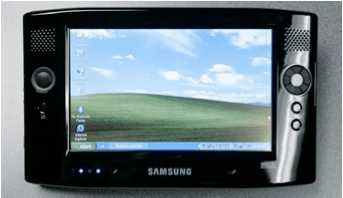
the Ultra-Mobile PC, or UMPC for short. The UMPC is
the culmination of the shrinking of the computer, (My how times have
changed!) a full computer that you can hold in the palm of your hand.
UMPCs run a full version of Windows XP Tablet PC edition, and, while
functional, they suffer from the complete lack of style that often
accompanies the PC marketplace. To remedy the outdated desktop, filing
cabinet metaphor and create a new computing utility we need to think
outside the start menu.
The computer operating system is the interface between the user and the
computer hardware. It is the software that makes the computer cold
silicone come alive and react to external stimulus. For personal
computers, there are several operating systems available, but only
Windows XP is widely known, mainly because of Microsoft’s 95% market
share. Every PC available for purchase comes preloaded with Windows, and
most users do not care to bother with another OS. While this is
seemingly convenient to the user, they are being forced to learn a
system that does not think like they do.
As stated earlier, there are several different PC operating systems. My
personal favorite is the Mac OS from Apple Computer. Mac OS is based on
the FreeBSD operating system, a freely available OS. Another type of
freely available OS is known as Linux. Linux is “open source”, meaning
that if so desired the source code is available and can be modified and
redistributed by anyone. Given the “free” and “open” nature of Linux,
there are literally hundreds of different “flavors” of Linux. Red Hat is
one of the better known flavors, along with Suse, Slackware, and Debian.
There are even flavors of Linux that are based off of other flavors. In
a market dominated by a multi-billion dollar company, Linux is truly an
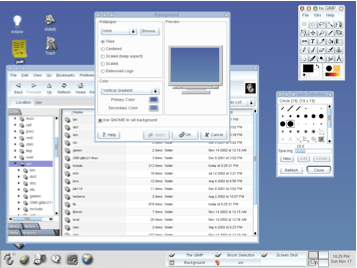
odd bird. It is unfortunate that the two major interfaces to Linux,
known as Gnome and KDE (The K Desktop Environment) both borrow heavily
from Windows XP, including a start menu, nested menus, and nested
folders. Linux, while free, suffers from a major drawback in being both
unfamiliar to regular users (not being Windows XP), and being
unintuitive to use (by trying to be Windows XP). Mac OS does a better
job of presenting a more discerning interface, but also suffers from
nested folders and other small interface drawbacks.
Gnome
KDE
Using a Mac can be made much more productive by installing the free
application named
Quicksiver
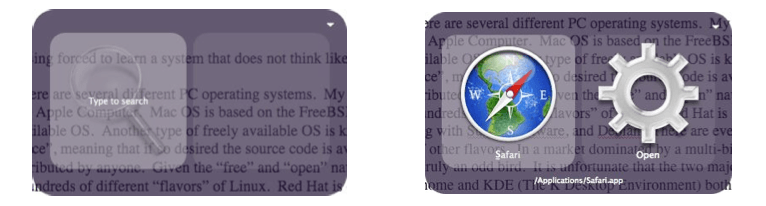
from Blacktree. Quicksilver runs in the background and waits until the
user presses a predefined key combination. Once the main Quicksilver
window is available, the user types in the first few letters of what he
is looking for, followed by a tab, and then the first few letters of
what the user wants to do with the item selected. For example, to launch
the Safari web browser, the user could type S <tab> O <enter> and the
application would launch. Quicksilver is a major leap forward in human
computer interaction, however it currently has a very steep learning
curve and takes some getting used to.
Quicksilver
Another great advancement on the Mac is called Spotlight. Spotlight
indexes all of the data on your computer, and all of the data about the
data (or metadata) in real time. Meaning, if I have an Adobe PDF file
that has something about Mezzo in it, spotlight will find it. Not only
files, but emails, music, picture and most other forms of data stored on
the computer. The Spotlight search functions almost instantly, building
its results in real-time as you type.
Searching instead of browsing with Spotlight
A creative Mac user named Jason Spisac recognized the short-comings of
the current computer interface and wrote a paper now known as the
“Mezzo Greypaper” detailing his idea of a new de-
sign for a GUI named
Mezzo. In
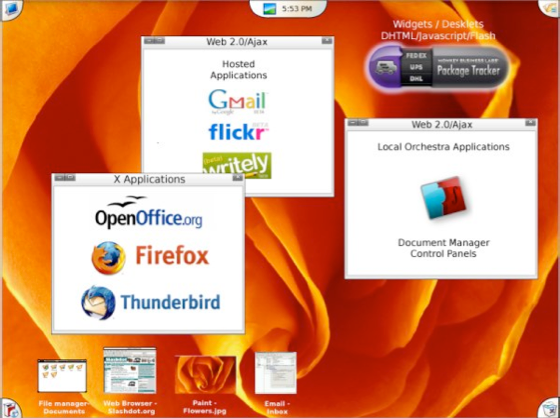
Jason’s paper, he details how major functions should be grouped in the
corners of the screen, where they cannot be missed with a mouse. This
idea was taken up by a group of Linux developers who are creating a new
Operating System named Sym- phonyOS. The SymphonyOS is still in
development, but it looks very promising. Using the ide- als and
standards described in the Mezzo Greypaper they have designed a GUI with
no file manager, hot corners, integrated search (via a linux application
named “beagle”, not as powerful as Spotlight, but not bad either), and
tight web integration.
The Mezzo Interface
Parts is Parts
The perfect user interface would incorporate all of the components
listed above; Mezzo desktop, integrated search, and a Quicksilver like
manager to bring it all together. I would like to propose a new UMPC, or
Tablet PC, or Navi, or whatever you would like to call it. I’ve become
fond of calling it the Farmdog.
The Original Farmdog Idea
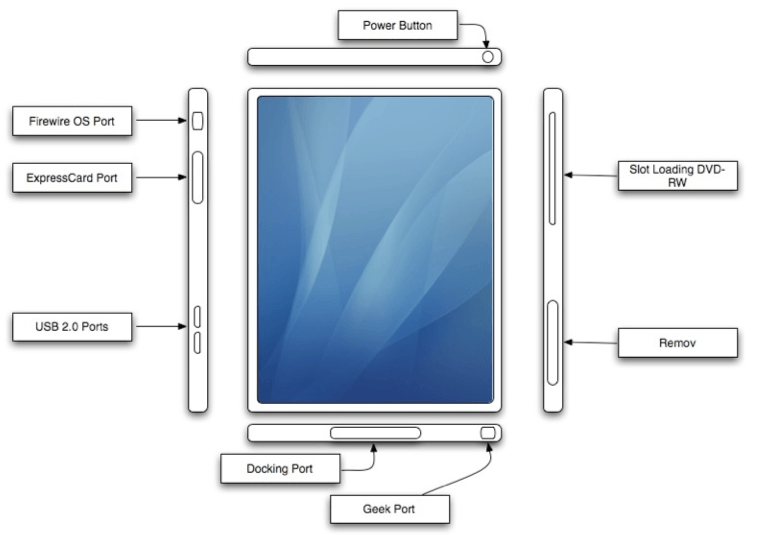
Farmdog is a type of hybrid, addressing the shortcomings of the major
computer systems, and designed for the user, not the computer
programmer. Using a touch screen and a stylus (or tablet pen) the user
can interface with the SymphonyOS using the Mezzo desktop’s hot corners
to bring up different functions or access different parts of the
computer. For example, moving the stylus into the lower left-hand corner
of the screen would bring up a full screen menu of the installed
programs. Bringing the stylus to the upper left-hand corner would give
the user a menu of available documents and an integrated search box.
Likewise, if something is no longer needed on the system, the user could
drag the item to the lower right hand corner and be rid of it. No
aiming, no hassle, no problem. Accessing quicksilver would be as easy as
a tap on the screen with the stylus. Using handwriting recognition
technology, the user could simply tap on the screen to bring up
quicksilver, write a S, then a line to the right, then an O, followed by
another tap to launch the Safari web browser. Likewise, the user could
tap on the screen, write a R and a P, then tap again to open the file
named “Research Paper”. All files, emails, applications, bookmarks…
everything available from one simple tap of the pen.
The Art of Tech
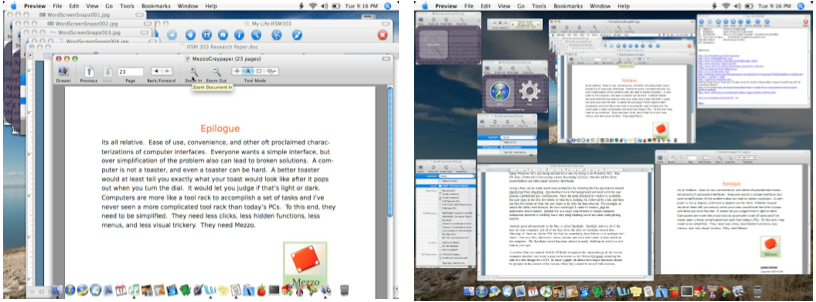
One other technology that I would borrow from Apple’s Mac OS is called
Exposé ́. Exposé is a window management system that allows the user to
see all open windows as thumbnails and then choose which one is needed.
The following two pictures illustrate Exposé. ́
Exposé
Utilizing this technology on a small hand-held computer would make the
headache of managing multiple application windows on a small screen a
thing of the past. Even better, Exposé can be activated via a hot
corner, say the upper right hand corner. So, the user has ten
applications open, and needs to copy some text out of a document for
inclusion in an email. Simply drag the stylus to the upper right hand
corner to activate Exposé ́, select the email application, copy the
text, back to the upper right hand corner, select the document, paste
and your done. It may not be as fast as other methods, but it is far
more natural.
Solutions
Software is only half the story. It is the ying to hardware’s yang.
Farmdog’s hardware is designed to deal with the current shortcomings of
computer design by using everyday technology in radically new ways.
Today, operating systems are distributed on a CD-ROM or DVD-ROM and
loaded (copied) onto the user’s computer hard drive. This system is
almost as old as computers themselves, with only the delivery method
changing (floppy disks to CDs to DVDs). The problem is that during an OS
upgrade, you run a very real risk of losing the data on the hard drive.
And what if there is a problem with the new OS? Unless you have copied
your data over to another hard drive somewhere else, there is no way to
go back a revision. Farmdog is different.
Farmdog would have two drives. One removable flash based drive for the
OS, and another standard hard drive for the user’s data. This system
would have a very distinct advantage over CD-ROM based delivery methods.
For one, with the entire OS on the flash drive, the user could switch
between operating systems by simply shutting down the Farmdog and re-
placing the flash drive. In this way, the user would not have to worry
about lost or damaged data, the data would be on a completely separate
drive. The hard drive would also be easily removable via a slot on the
right hand side of the computer. I can imagine distributing a simple
hard drive replicator to backup data even further.
Nothing New Under The Sun
I really enjoy computers. I’ve enjoyed them even more since switching to
Mac. I enjoy them so much that I’ve made a career out of knowing as much
as possible about how they work, and what makes them tick. Farmdog is
about putting a little piece of soul back in the box, finding the ghost
in the machine and setting it free. Computing without thinking, finding
without doing. Farmdog wants to be your best friend.



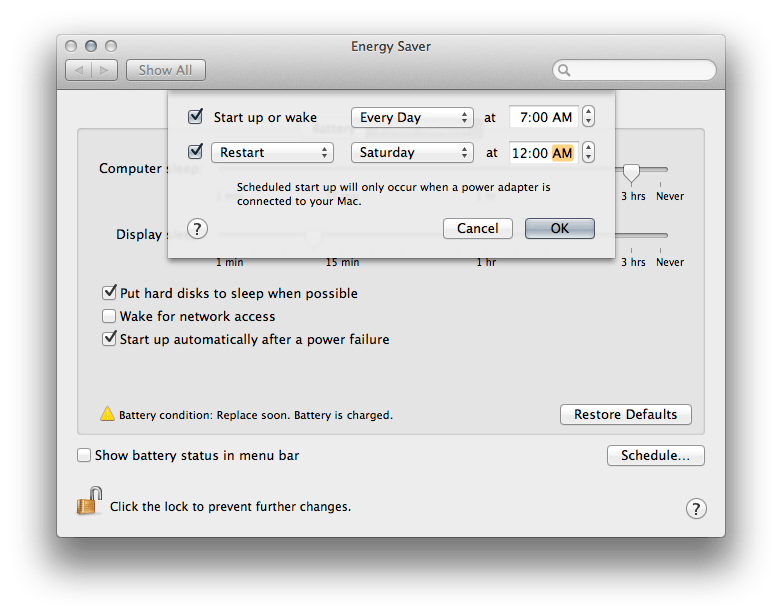
 My MacBook at work sits on my desk all
day and all night. When I sit down to work on it, I expect it to be
ready for me, and ready to ask how high when I tell it to jump. I get a
bit annoyed if I come back after a few minutes or an hour and find that
the Mac has gone to sleep while I’ve been gone. So, I spent a few
minutes in the Energy Saver preference pane to configure the machine to
my schedule.
My MacBook at work sits on my desk all
day and all night. When I sit down to work on it, I expect it to be
ready for me, and ready to ask how high when I tell it to jump. I get a
bit annoyed if I come back after a few minutes or an hour and find that
the Mac has gone to sleep while I’ve been gone. So, I spent a few
minutes in the Energy Saver preference pane to configure the machine to
my schedule.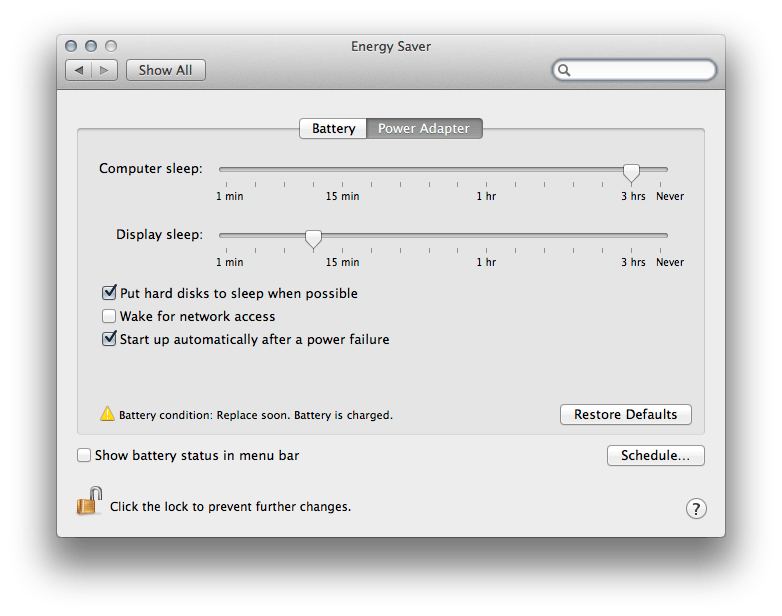
 OmniWeb -
 Yojimbo -
 Delicious Library - I love organizing things, and